As organisations scale their data infrastructure, one challenge consistently rises to the surface: understanding where data comes from, how it moves, and what it means. Automated data lineage tools address this challenge head-on, transforming complex, distributed data environments from sources of confusion into traceable, auditable systems. Whether you are managing a cloud data warehouse, a hybrid architecture, or a real-time streaming pipeline, data lineage has become a non-negotiable pillar of modern data governance.
What Is Data Lineage and Why Does It Matter?
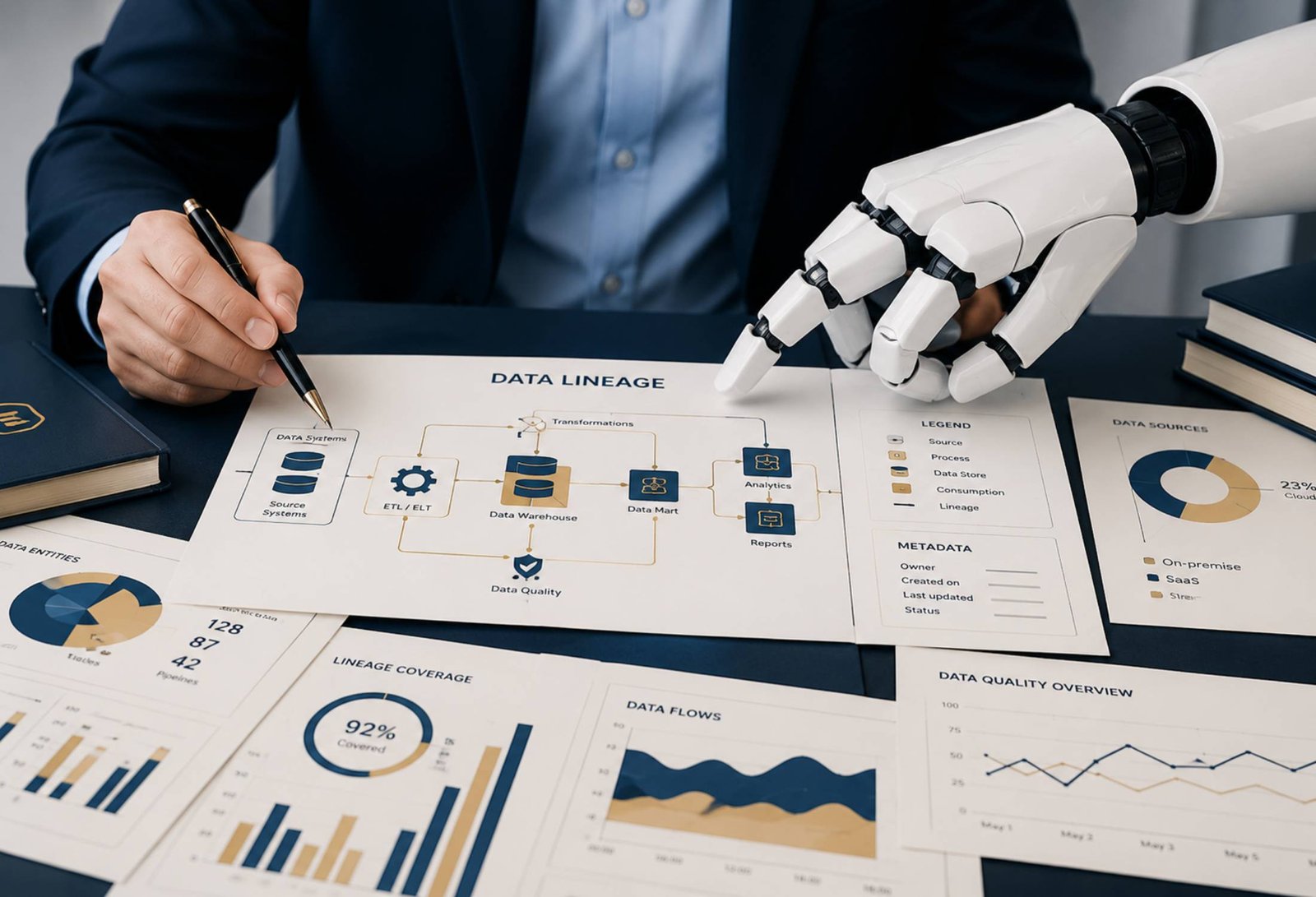
Data lineage is the ability to track the full lifecycle of data: its origins, every transformation it undergoes, and where it ultimately flows across your systems. At its core, data lineage transforms chaos into clarity. Without it, data engineers and analysts are left guessing whether a dashboard figure reflects a clean, trusted source or a pipeline riddled with silent errors.
In an era of increasing regulatory scrutiny, from GDPR and CCPA to SOX and BCBS 239, automated data lineage is also a compliance imperative. Auditors and data protection officers need to demonstrate that every decision traces back to a trusted, governed source. Manual documentation simply cannot keep pace with the velocity of modern data pipelines.
The Five-Layer Architecture of Automated Data Lineage
The most robust automated data lineage solutions are built on a five-layer architecture, each layer serving a distinct purpose in the end-to-end tracking process:
- Automated Capture Layer: Scans ETL jobs, API calls, SQL queries, and data transformation scripts to extract lineage metadata without requiring manual input from engineers.
- Graph Database Storage: Stores captured relationships in a property graph, enabling complex queries about data dependencies, upstream sources, and downstream consumers.
- Interactive Visualisation: Provides intuitive, explorable diagrams that allow data teams to navigate dependencies, identify bottlenecks, and communicate data flows to business stakeholders.
- Impact Analysis Engine: Predicts downstream effects before changes are made, enabling teams to assess which dashboards, reports, or ML models will be affected by an upstream schema change.
- Policy and Compliance Engine: Triggers automated compliance checks, data quality alerts, and access control evaluations whenever sensitive data traverses governed boundaries.
Column-Level Lineage: The Key to Faster Debugging
Table-level lineage tells you that Dataset A fed into Dataset B. Column-level lineage tells you precisely which field in Dataset A was used, how it was transformed, and where it ended up in Dataset B. This granularity is what separates mature data lineage implementations from basic metadata catalogues.
Column-level data lineage dramatically reduces debugging time. When a KPI suddenly shifts, engineers can trace the anomaly to the exact transformation step, column expression, or source system rather than manually inspecting entire pipelines. For organisations operating across hybrid cloud environments and multiple data warehouses, this precision is indispensable. Mapping precise dependencies across platforms like Snowflake, Databricks, BigQuery, and on-premises databases requires tools that operate at column-level granularity by default, not as an afterthought.
Federated Data Lineage for Distributed Architectures
Modern enterprises rarely operate from a single, centralised data platform. The rise of data mesh architectures, domain-oriented data ownership, and decentralised data products means lineage solutions must support a federated model. Federated lineage delivers domain-specific views, giving individual teams the context they need, whilst preserving enterprise-wide consistency for governance and compliance teams.
This is especially critical for fast-evolving data architectures where schemas change frequently, new sources are onboarded rapidly, and cross-domain data products are assembled from multiple upstream contributors. A federated lineage approach ensures that governance policies propagate consistently without creating bottlenecks at the centre of your data organisation.
Key Challenges: Streaming Pipelines and Petabyte-Scale Graphs
Despite significant advances, automated data lineage tools still face two persistent challenges. First, streaming pipelines, built on Apache Kafka, Flink, or Kinesis, often evade standard lineage capture methods. Traditional parsing techniques designed for batch SQL are ill-suited to continuous, event-driven architectures where data transformations occur at sub-second intervals.
Second, petabyte-scale lineage graphs present serious scalability questions. As organisations ingest more sources and track more transformations, lineage graph databases must handle exponentially growing relationship networks without degrading query performance.
Hybrid extraction methods are emerging as the most effective solution to both challenges. By combining agent-based scanning, which monitors pipeline execution in real time, with query parsing, which analyses transformation logic at the code level, modern tools can capture lineage across batch and streaming workloads alike. This hybrid approach bridges the gap between operational resilience and analytical completeness.
How Granular Should Your Data Lineage Be?
One of the most important strategic questions in any data lineage implementation is: how granular should lineage be for operational resilience versus analytical exploration? There is no universal answer, and getting it wrong in either direction carries real costs.
For operational resilience, fine-grained column-level lineage is essential. Incident response, root cause analysis, and impact assessment all depend on knowing exactly which fields are affected and which downstream assets are at risk. In this context, more granularity is almost always better.
For analytical exploration and broader data discovery, however, excessive granularity can create noise that obscures rather than illuminates. Business users navigating a data catalogue do not need to see every intermediate column transformation; they need a clear picture of where data originated and whether it meets quality standards. The most mature lineage frameworks are tiered, offering high-resolution operational views for engineers and simplified, trust-focused views for analysts and data consumers.
Choosing the Right Automated Data Lineage Tool
When evaluating automated data lineage solutions, organisations should assess the following capabilities:
- Native integrations with your existing stack: cloud warehouses, orchestration tools, BI platforms, and data catalogues.
- Support for both batch and streaming extraction methods.
- Column-level granularity as a standard feature, not a premium add-on.
- Scalability benchmarks relevant to your data volume and pipeline complexity.
- Governance and compliance policy engine capabilities, including role-based lineage views and audit trail export.
Assess Your Data Lineage Maturity with GovernData
Understanding where your organisation sits on the data lineage maturity curve is the first step towards building a framework that scales with your architecture. GovernData assesses your current lineage capabilities, identifies critical gaps, and designs bespoke frameworks tailored to your technology stack, regulatory environment, and business objectives.
Book your consultation today and take the first step towards a data environment where every decision is traceable, every pipeline is auditable, and every stakeholder can trust the numbers they work with.