Data mesh represents one of the most significant architectural shifts in enterprise data management of the past decade. By distributing data ownership to the domain teams closest to the data, mesh architectures address a fundamental scaling problem: central data teams cannot keep pace with the data needs of every business unit across a large organisation. But decentralisation without governance is simply chaos with better branding. Federated computational governance is the mechanism that makes data mesh work at enterprise scale.
Data Mesh Flips Governance Inside Out
In a traditional centralised data architecture, governance flows from the top down: a central data team defines standards, owns the pipelines, and enforces quality. This creates consistency but at the cost of agility — every data request must pass through a central bottleneck, and domain teams wait weeks for data products that could theoretically be built in days.
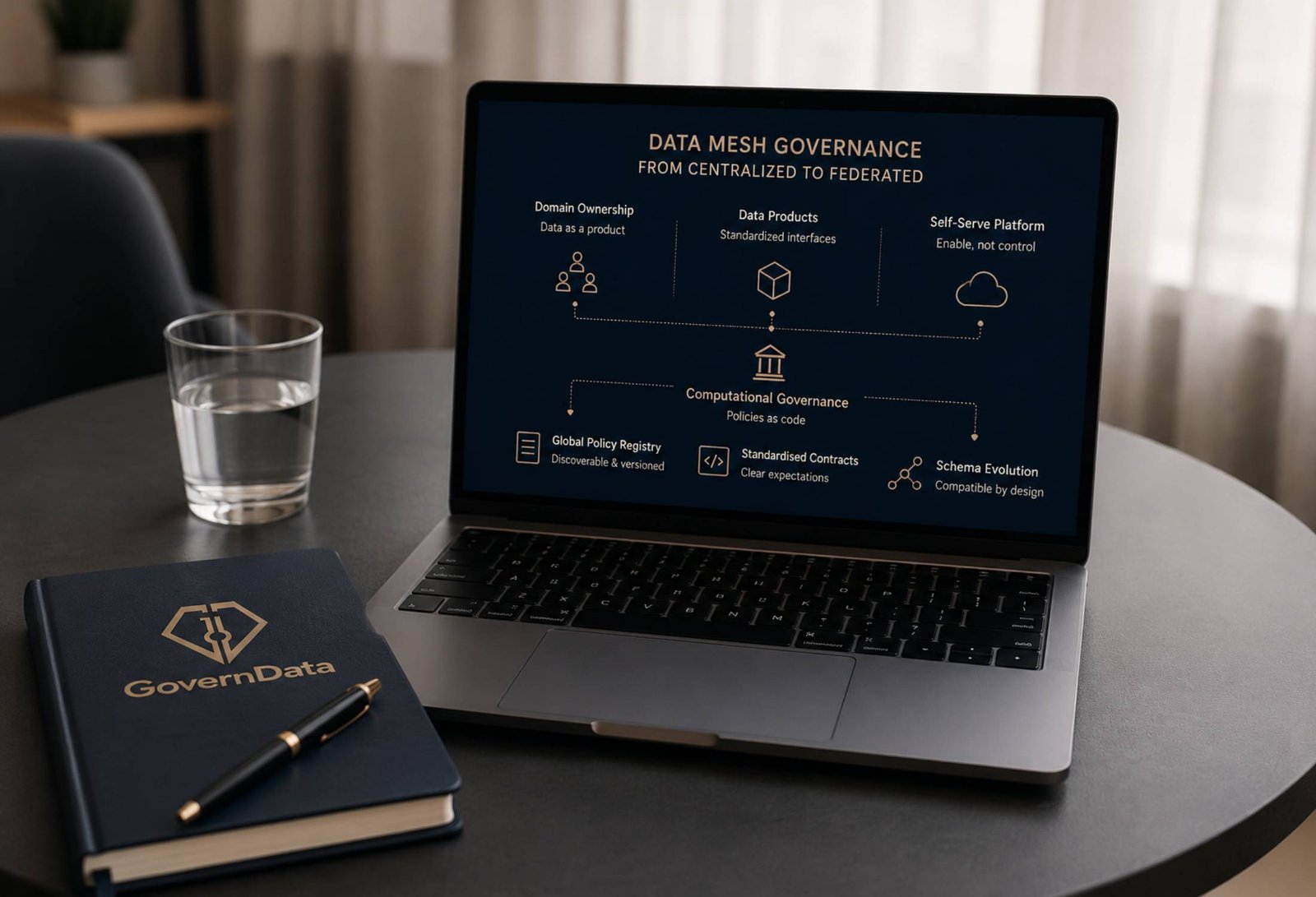
Data mesh inverts this model. Domains own their data products and are accountable for their quality, availability, and fitness for consumption. Governance does not disappear — it transforms. Rather than being enforced by a central team reviewing each data product manually, governance becomes computational: codified as executable policies that run automatically whenever data crosses domain boundaries, is published to the mesh, or is consumed by another domain.
The Four Principles of Data Mesh and Their Governance Implications
Successful data mesh implementations are built on four interdependent principles, each with significant implications for how governance must be designed:
- Domain-Oriented Ownership: Each business domain — marketing, finance, logistics, and so on — owns the data it produces and is accountable for maintaining it as a product. Governance must be lightweight enough that domain teams can adopt it without becoming data engineers.
- Data as Products: Domains publish their data with clear interfaces, documented SLAs, and explicit quality commitments. Governance frameworks must define what a well-formed data product looks like and provide tooling for domains to meet those standards independently.
- Self-Serve Data Platform: The infrastructure layer provides domains with the tools to build, publish, and monitor their data products without central intervention. Governance tooling must be embedded in this platform rather than bolted on separately.
- Federated Computational Governance: Policies that would traditionally require human enforcement are translated into code — access controls, quality checks, lineage requirements — and applied automatically across all domain data products.
What Computational Governance Actually Means in Practice
The phrase ‘computational governance’ describes the translation of business rules and regulatory requirements into executable code that runs automatically across the mesh. Where a traditional governance framework might require a data steward to manually review and approve a new data product before it is published, a computational governance framework deploys automated checks that validate the product against defined standards before it is made discoverable.
In practice, computational governance covers several critical areas. Access controls are enforced not by manual permission reviews but by policy-as-code that evaluates every data access request against defined rules in real time. Quality thresholds are validated at publication time and continuously monitored thereafter. Lineage requirements ensure every data product declares its upstream dependencies, enabling impact analysis across domain boundaries. Privacy and compliance rules — GDPR data minimisation requirements, HIPAA de-identification standards — run as automated checks rather than periodic audits.
Standardised Contracts and the Global Policy Registry
For cross-domain data consumption to work at scale, domains must publish their data products in a standardised, discoverable format. This is where the global policy registry becomes central to federated governance. Each domain publishes a data contract to the registry: a machine-readable specification that declares the schema, SLAs, quality commitments, access requirements, and lineage of the data product.
This contract-first approach enables cross-domain discovery without central chokepoints. A data scientist in the analytics domain can query the registry to find data products that meet their requirements — appropriate freshness, required fields, permitted access — without needing to contact the owning domain team directly. The registry validates that contracts are well-formed and that domains are meeting their published commitments, surfacing SLA breaches automatically.
Schema Evolution and Interface Stability
One of the most technically demanding aspects of federated governance is managing schema evolution without breaking downstream consumers. In a centralised architecture, schema changes can be coordinated centrally. In a mesh, domain teams evolve their schemas independently — and consumers across the organisation depend on the stability of those interfaces.
The most robust federated governance frameworks implement explicit versioning policies: domains must maintain backward-compatible interfaces for a defined deprecation period, announce breaking changes through the registry with advance notice, and provide migration guides for affected consumers. Computational governance tools can automatically detect breaking changes in proposed schema updates and block publication until the domain team has addressed the compatibility implications.
The Challenge of Transitional Architectures
Very few organisations have the luxury of building a data mesh from scratch. Most face the far harder challenge of transitioning from existing centralised architectures — legacy data warehouses, central ETL pipelines, and monolithic data platforms — to a domain-oriented mesh, whilst keeping the business running throughout.
Transitional architectures inevitably create friction between the old governance model and the new one. Central teams accustomed to owning all data pipelines must learn to function as platform providers rather than producers. Domain teams must develop new competencies in data product management. Computational governance frameworks must coexist with legacy manual processes during the transition, enforcing standards where possible and flagging gaps where the new model is not yet fully in place.
Can Centralised Governance Scale to Mesh Realities?
The honest answer is no. At the scale and velocity that modern data mesh architectures operate, traditional centralised governance cannot keep pace. Policies must become truly computational — not because it is technically elegant, but because it is the only governance model that scales to the distributed, autonomous reality of a mature data mesh.
Accelerate Your Mesh Governance Transition with GovernData
GovernData guides organisations through data mesh governance transitions with proven frameworks — from designing federated policy registries and data contracts to embedding computational governance into self-serve platform tooling.
Request your federated governance assessment and build a mesh that is as well-governed as it is agile.