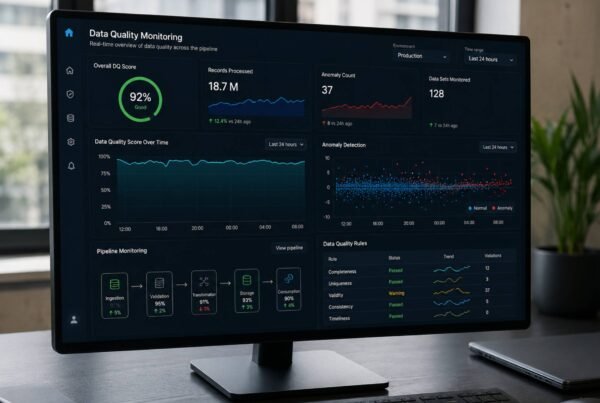

Data observability has undergone a profound evolution over the past few years. What began as a collection of pipeline health checks and data quality dashboards has matured into something considerably more sophisticated: autonomous observability platforms capable of predicting failures before they occur, diagnosing root causes through causal analysis, and taking corrective action without waiting for a human to intervene. For data teams managing complex, distributed architectures at scale, this shift from reactive monitoring to autonomous governance is not incremental — it is transformational.
The Evolution From Reactive to Autonomous Observability
First-generation data observability tools were essentially monitoring dashboards: they collected metrics about pipeline runs, flagged anomalies against static thresholds, and sent alerts when something looked wrong. Useful, but fundamentally reactive. The engineering team still had to investigate, diagnose, and fix problems manually — and by the time the alert fired, downstream consumers had often already been affected.
Second-generation platforms introduced ML-based anomaly detection and improved alert correlation, reducing noise and improving detection accuracy. But the human was still in every remediation loop.
Autonomous observability platforms represent the third and current frontier. They ingest rich telemetry streams — metrics, traces, events, and logs — across the entire data lifecycle and use AI models not just to detect anomalies but to predict quality drift before it materialises, infer lineage relationships automatically, and trigger remediation workflows without human initiation.
The Five Telemetry Signals That Power Autonomous Observability
Effective autonomous observability depends on collecting and correlating five core telemetry signal types across every component of the data stack:
- Freshness Signals: Track when datasets were last updated relative to their expected refresh cadence. Freshness monitors flag stale data before consumers query it, enabling proactive communication and preventing decisions based on outdated information.
- Volume Anomaly Detection: Monitor the row counts, file sizes, and record volumes produced at each pipeline stage. Sudden drops in volume are often the earliest detectable symptom of an upstream failure, catching issues that quality checks on content would miss entirely.
- Schema Evolution Tracking: Detect changes to field names, data types, and table structures automatically. Schema drift is one of the most common causes of silent data pipeline breakage, and autonomous platforms can block downstream consumption of schema-changed datasets until compatibility is confirmed.
- Distribution and Statistical Profiling: Continuously monitor the statistical properties of key columns — mean, standard deviation, cardinality, null rates — and flag deviations from learned baselines. This catches semantic drift, where values remain technically valid but have shifted in business meaning.
- Pipeline Execution Telemetry: Collect runtime metrics from orchestration tools, transformation engines, and ingestion frameworks. Execution anomalies — unusually long run times, elevated error rates, resource consumption spikes — are leading indicators of data quality issues that will manifest downstream.
AI Agents in the Observability Stack
The defining characteristic of truly autonomous observability platforms is the presence of AI agents capable of taking action, not just raising alerts. These agents operate continuously across the pipeline, performing several critical functions.
When a pipeline stage produces anomalous output, an agent can automatically pause the flow — preventing corrupt or degraded data from propagating to downstream consumers — and trigger an investigation workflow that gathers diagnostic context before human review. When a data quality issue is detected, an agent can enrich the affected dataset’s metadata with quality annotations, ensuring that consumers and catalogues immediately reflect the current trust status of the data.
Causal analysis capabilities allow agents to surface root causes rather than just symptoms. Rather than alerting that table X has elevated null rates, an autonomous observability platform can determine that the nulls originated in a specific upstream API feed that began returning incomplete responses six hours ago, and that three downstream dashboards and one ML model are currently consuming affected data.
Self-Optimising Coverage: Balancing Cost and Signal Quality
As data volumes grow and pipeline complexity increases, comprehensive observability coverage becomes expensive. Monitoring every column of every table at the same frequency and intensity is neither cost-effective nor technically necessary. Self-optimising observability platforms address this by dynamically adjusting monitoring intensity based on business criticality and historical risk profiles.
Datasets that feed executive reporting, financial calculations, or customer-facing products receive intensive monitoring with tight anomaly detection thresholds. Exploratory data science sandboxes and low-criticality archival datasets receive lighter coverage. This priority-weighted approach ensures that observability budgets — both financial and computational — are concentrated on the data that matters most to the business.
Integration Challenges: Overcoming Siloed AI Telemetry
The most significant technical barrier to autonomous observability is the fragmentation of telemetry data across multiple tools. A mature data stack might involve a cloud data warehouse, a transformation layer, a streaming platform, an orchestration engine, a data catalogue, and several BI tools — each generating its own telemetry in its own format, stored in its own system.
Siloed AI telemetry fragments the insights that autonomous observability requires. An anomaly that is clearly visible when pipeline execution metrics, data quality scores, and lineage events are correlated becomes invisible when each signal is analysed in isolation. True autonomy demands unified signal processing across the entire data lifecycle, which in practice requires purpose-built integration layers that normalise and correlate telemetry from every component of the stack.
The Risk of Over-Automation: Preserving Human Oversight
As autonomous observability platforms become more capable, a genuine risk emerges: over-automation that masks systemic issues rather than resolving them. If agents are auto-remediating pipeline failures faster than engineers are reviewing them, the underlying causes of those failures may never be addressed — the system simply keeps patching symptoms while the root problem grows.
Mature autonomous observability architectures therefore incorporate explicit human oversight mechanisms: escalation thresholds that require human review before automated actions above certain impact levels are taken, audit logs of every autonomous action for post-incident review, and governance policies that define which categories of remediation are appropriate for full automation versus human-in-the-loop workflows.
How Intelligent Must Observability Become?
The question facing data leaders today is not whether to invest in autonomous observability, but how intelligent it must become before it genuinely governs proactively rather than just reports. The answer will differ by organisation — determined by pipeline complexity, data volume, regulatory requirements, and risk tolerance. But the direction of travel is clear: observability that merely monitors is becoming table stakes, while observability that predicts, explains, and acts is becoming the competitive differentiator.
Build Your Observability Roadmap with GovernData
GovernData evaluates observability maturity across your current data stack, identifying gaps in telemetry coverage, opportunities to introduce autonomous remediation, and the integration priorities that will deliver the fastest improvement in pipeline reliability and data trust.
Contact us for your observability consultation and take the first step towards a data platform that governs itself.